Saturday, January 16, 2016

Want to Increase Trust? Increase Your Say/Do Ratio!

by Bill Sanders, Principal and Sr. Consultant with Roebling Strauss

Biz Stone was recently invited to speak at private gathering for one of our clients to discuss design thinking. What followed was an engaging exchange across, not just the topic at hand, but across a litany of subjects driving current events, leadership and other business issues. In response to a question, Biz made the following comment.

"Say, do. Say, do. Say, do. It's the only way to build trust."


I found his comment a much more succinct summation of my philosophy: If you want to build trust, make and keep commitments.

Think about that for a moment. Think about the people you work with, clients, vendors, co-workers. Who do you trust and why? Who trusts you?

My experience is that we tend to trust those people who do what they say they will, when they say they will, and deliver the expected level of quality. Delivering on our commitments is a key component of building trust.

Requesting, negotiating, making, managing, and keeping commitments is something we are all engaged in on a daily and sometimes even hourly basis. And those of us with high expectations of ourselves and our work are acutely embarrassed when we miss a deadline, forget a promise, or produce something that doesn't meet expectations.

That insight and our desire to personally up our own performance was one of the key drivers for Chris Heuer , Rawn Shaw , and I to co-found Alynd in 2013. And while the product has pivoted due to market demand, we experienced and learned much from the initial foray into the development of commitment management software. Especially when we began using it ourselves.

Immediately upon completion of our first prototype, we began using the software to manage our commitments to one another. And it was successful in terms of helping us keep our commitments to one another, with one massive side effect; what we gained in the consistency of keeping our agreements, we initially lost in sleep.

Here are my key learnings on how to keep a high Say/Do ratio and still get a good night's sleep:

Ask the Right Questions

Moving from a rather fluid, effort-focused start up mentality to one of explicit agreement requires everyone engaged in the project to be on the same trajectory. If I know exactly what you want, and have done it before, I have a much better chance of estimating the resources and time required before I make another commitment to you. I must know what it is you expect. Sometimes more importantly, I need to know what you don't expect.

I now recommend that you always define quality criteria (what "it" is and what "it" is not) for deliverables. Ask questions about budget limitations, design boundaries, and competing commitments related to the project. Find out what the consequences are for not meeting the objective by the requested deadline.

Time Is a Priority

As Alan Weiss is fond of saying, "Time is not a resource, time is a priority."

Considered separately, many requests were clearly possible to complete in a week. But from a holistic viewpoint, I couldn't complete them all. After a couple of weeks using the new tool, my delivery was near 100%, but I was getting no sleep. The culprit? I was making immediate commitments to requests, without systematically considering other commitments I had already made, or evaluating the priorities of the new requests.

The interesting thing here is that our prototype was highlighting a way of operating as well as keeping me aware of all the commitments I had made. It didn't take long to learn the phrase "Let me evaluate that and I'll get back to you this afternoon with my commitment."

Build in Margins


Closely related to priority, I found that if I was going to keep all my commitments, then making less of them wasn't going to do the trick all by itself. Inevitably, things come up. Opportunities present themselves. Trains don't run on time. As I monitored the results, I became much more adept at leaving unscheduled time in my calendar so that the unexpected didn't have to come out of my sleep.

I now generally leave prep time and follow up time for meetings. And I'm more selective in the meetings that I do commit to attend. This makes a tremendous difference at the end of the day when I'm not left with two hours of follow up.

Want to improve trust? Improve your Say/Do ratio. Here are three simple tips.

  1. Confirm all commitments in writing. Send an email reiterating who will do what for whom by when. The simple act of writing it down will help you remember it as well as allow the other party to clarify any misunderstandings immediately.

  2. Track your commitments. Use whatever tool best fits your operational style. It can be a whiteboard, your calendar, or an excel spreadsheet. Two keys; everything has to be on it, and you have to be able to access it.

  3. Track your progress. On a week by week basis track how many commitments you made and kept. While it is difficult to track trust, it is easy to track if you are keeping your commitments.


It feels good when you know you are delivering, which of course increases your ability and energy to deliver. Develop the habit of saying and then doing; of promising and then delivering. It's a virtuous cycle that's addictive. And it will pay huge dividends in your personal and professional life.

Bill Sanders is Principal and Sr. Consultant with Roebling Strauss, a boutique consultancy that specializes in delivering dramatic improvements in organizational effectiveness: co-founder and Advisory Board Member of Will Someone, software that facilitates and supports team alignment through commitments: and Co-Lead Link of the Finance Circle for Great Work Cultures, a community dedicated to creating a new norm for work cultures that optimize worker effectiveness and human happiness. Connect with Bill on twitter at @technacea.

2016-01-16-1452984487-6743279-BillSanders_RSIHeadshot_clr.jpg

-- This feed and its contents are the property of The Huffington Post, and use is subject to our terms. It may be used for personal consumption, but may not be distributed on a website.




5 Questions to Make Today Your Best Day

2016-01-16-1452944281-4406551-nov29.jpg

As an entrepreneur you often start out doing everything yourself. Social Media, copywriting, building websites and landing pages, sales funnels, learning new technology, creating content... and so much more.

It can be very overwhelming and hard to know which actions will push you and your business forward.

I know it was a challenge for me to finally understand that often I am keeping busy instead of working productively towards my goals.


The following 5 questions will help you:
- stay centered and not let others take over your schedule
- create real progress in your business
- keep a high energy
- invite miracles into your day
- manage your mind to stay focused on success


Watch this video to find out about the tips:


Here is the wrap up:
5 questions that will make your days better and better

1) How can I serve today?
This question hands over your day to serve a bigger purpose. Take a moment and listen to the ideas and visions.

2) What are the 3 todo's that I need to take care of today to facilitate progress?
This helps you to focus on what is really needed to move ahead in your business and life, instead of keeping busy.

3) How can I take care of myself today?
In order to have the motivation, drive and energy to build a life and business you truly love, you need to recharge your batteries every day. Burning yourself out will keep you stuck.

4 ) How can I make today the best day?
Every day has a different potential, yet you can always find beauty, fun and happiness in your day.

5) What affirmation can support me today?
Ask yourself whether you have worries, doubts or fears that might stop you from achieving your goals for this day. Turn your worries around, come up with an affirmation that will support your growth and put yourself in a positive mindset.

For my free course Activate Your Business Alchemy that will help you unblock and strategize forward movement, click here

-- This feed and its contents are the property of The Huffington Post, and use is subject to our terms. It may be used for personal consumption, but may not be distributed on a website.


A Legal Overview of Religious Discrimination in Employment

Title VII of the federal Civil Rights Act of 1964, among other requirements, prohibits discrimination in employment based upon religion for covered employers who have 15 or more employees (42 U.S.C. Sec. 2000e). Employees' religious beliefs and practices are entitled to "reasonable accommodation" in the workplace unless it would cause the employer an "undue hardship." Asserted claims of prohibited discrimination must typically be made to the Equal Employment Opportunity Commission (EEOC) or comparable state agency within 180 days of the discriminating event. Note that many states have similar statutes that may include more employers or have different procedural requirements. This comment provides a brief and incomplete educational overview of the complex topic of religious discrimination in private sector employment. Public employees have a somewhat different situation. Always contact an experienced employment discrimination attorney in a specific situation.

Courts have difficulty precisely defining "religion." Courts do not judge religious doctrines. This is as ancient as the Biblical account in Acts 18 of a Roman Proconsul declining to hear such a case. Numerous modern U.S. court decisions address employer "undue hardship." These cases may conclude, for example, that since customers prefer that employees without tattoos serve them, it is an undue hardship if an employer cannot require their covering, even if the tattoos are religiously inspired.

Courts state that a religious belief or practice is "sincere," "central," "influences behavior," and addresses "ultimate ideas" concerning "life, purpose, and death." However, the courts have concluded that "religion" may exist without the individual believing in a traditional Deity or acting in conformity with an established religious group. In other words, it is legally possible to have a one person "religion."

Courts distinguish "religion" from social, political, or ethical viewpoints. Personal preferences in appearance such as hairstyle, clothing, or jewelry do not constitute "religion." Nutritional preferences or political affiliations are not "religion." The analysis becomes very factually specific. A religious practice or belief is "sincerely held" ("bona fide") based upon both the employee's subjective belief and objective practice. While a court will not determine the ultimate truth or reasonableness of the subjective religious belief, the court will take note of consistent objective practice. The employee must be consistent in belief and practice in order to successfully assert religion.

Courts have determined that both "disparate treatment" (different treatment due to the employee's religion) or a failure to "reasonably accommodate" an employee's religious belief or practice (absent employer undue hardship) are forms of unlawful religious discrimination in employment. Precisely what is a "reasonable accommodation" in a specific situation? This is fact specific.

Note that not only must the employee have a bona fide religious belief, she or he must typically inform the employer of this belief. Why did the employer take the adverse employment action in question? Did the employee fail to comply with a job requirement that conflicted with the communicated religious belief when a reasonable accommodation was possible? A 2015 U.S. Supreme Court decision (8:1) involved a successful lawsuit by a prospective employee who was denied employment after wearing a hijab to an employment interview but without requesting a religious accommodation (EEOC v. Abercrombie & Fitch). However, this case involves unique facts.

Consequently, from the employer's viewpoint:

1. Is there notification or reason to know that a reasonable religious accommodation may be appropriate?
2. If so, initiate communication with the employee concerning possible accommodations. The accommodation process involves cooperation and dialogue and cannot be unilaterally undertaken by either party.
3. Listen to the employee's request and why the employee wants it.
4. An employer does not have to provide the employee with her or his requested accommodation if the employer prefers to provide a different but reasonable alternative.
5. An employer needs to be factually objective concerning what accommodation is reasonable or might create an undue hardship.

The following are some general types of proposed reasonable accommodation:

1 . Flex schedules or personal leave policies.
2. Schedule and shift exchanging done voluntarily.
3. Modification in employer grooming standards or dress codes.
4. Voluntary transfers and sometimes voluntary demotion. Be cautious.
5. Allowing non-disruptive prayer and/or religious conversation outside of customer service areas. This is very fact specific.

An employer might possibly reject a proposed accommodation because it:

1. Imposes more than a de minimis (very small) cost or administrative burden.
2. Creates building or business code violations, or other legal violations or safety issues.
3. Violates contract rights or a collective bargaining contract.
4. Creates workplace disruption, workplace conflicts, or damages customer interactions. Be factually objective.
5. Adversely impacts the corporate brand or creates community disdain.

Office of Federal Contract Compliance Programs regulations require federal contractors and subcontractors to provide employees and prospective employees with accommodations for religious observance and practice, specifically mentioning Sabbath and religious holiday observance (41 CFR 60-50.3). However, in determining what might constitute an undue hardship to the employer, the regulation states that factors such as business necessity, financial costs and expenses, and resulting personnel problems may be considered.

Religious faiths and religious educational institutions may discriminate on the basis of religion in employment decisions. Additionally, when an employee's conduct is contrary to the religious principles of the religious institution, the employee may be terminated. However, determining if a particular employer is "religious" may be difficult. Courts frequently examine the relative mixture of secular and religious activities occurring within the organization.

"Ministerial" employees are not allowed to sue religious employers under anti-discrimination statutes, including the Americans with Disabilities Act, as decided by the U.S. Supreme Court in a 2012 unanimous decision (Hosanna-Tabor Evangelical Lutheran Church and School v. EEOC). The teacher in question had completed a course of theological study and accepted a "call," teaching both religious and secular classes in kindergarten and the fourth grade. After a dispute with her employer concerning disability leave for narcolepsy, she was terminated. Upon reviewing the facts of this situation, as well as the history of religious liberty and the First Amendment, the Supreme Court concluded that the ministerial exception bared her lawsuit. The Court noted that it expressed no opinion concerning whether or not the ministerial exception would prohibit other types of lawsuits, such as breach of contract or tort (injury).

Consequently, a religious employee would be advised to have a written employment contract containing provisions for disability and severance benefits, etc.

The federal Religious Freedom Restoration Act of 1993, in broad overview, prohibits government from substantially burdening one's exercise of religion unless the government demonstrates a compelling interest and the governmental burden is the least restrictive method to address this compelling interest (42 U.S.C. Sec. 2000bb-1). In 2014 the U.S. Supreme Court utilized this statute to limit regulations under the federal Affordable Care Act that required employers to provide health insurance coverage for some methods of contraception (Burwell v. Hobby Lobby Stores). This complex topic is beyond the scope of a brief comment.

This comment provides a brief and incomplete educational overview of a complex topic and is not intended to provide legal advice. Always contact an experienced employment discrimination attorney in a specific situation.

-- This feed and its contents are the property of The Huffington Post, and use is subject to our terms. It may be used for personal consumption, but may not be distributed on a website.


Meet Deep Patel: 17-Year-Old Wunderkind

Meet seventeen-year-old, Deep Patel.

2015 was a great year for Patel. He had an opportunity to interview high-profile individuals - including the former Director of the CIA. He published a book and he secured a deal to co-author another book with a Hollywood producer and screenwriter.


2016-01-16-1452903935-4701179-Deep_Patel.jpe


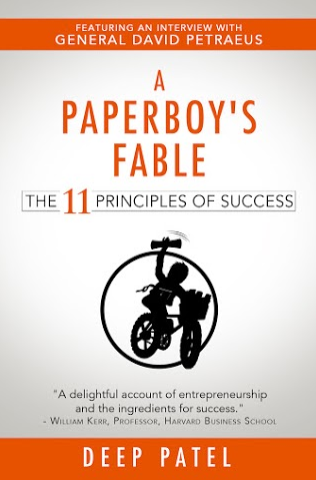
His first book, A Paperboy's Fable, describes the 11 Principles of Success, as demonstrated by a paperboy named Ty, who chooses one of the least growth-centric professions going and manages to make a mint.

2016-01-16-1452903858-8967558-paperboyfable_image.jpg


As a bonus, the book also contains interviews with luminaries of the business, academic, and political spheres. General David Petraeus, CNET co-founder Gina Smith, and Vine cofounder Rus Yusupov each share their thoughts and wisdom - which have been seamlessly interwoven into the book.

William Kerr, Professor at Harvard Business School and Faculty Chair of the Launching New Ventures program for Executive Education, offers his commendation for Patel. Kerr praises the work, declaring, "prescient and insightful well beyond his years, Deep Patel provides a delightful account of entrepreneurship and the ingredients for success."

When asked what inspired him to write a business fable, Patel replied, "My dad was a paperboy at my age. He is always telling me about his experiences as a paperboy, and this was decades ago when he made way less than the minimum wage."

2016-01-16-1452904030-4727555-A_PaperBoys_Fable.PNG


With representation from former Wiley directorial editor, Debra Englander, Patel is the youngest author to sign with Post Hill Press (distributed by Simon & Schuster). Post Hill Press has published the works of many celebrities, political figures, and reality TV stars.

After a year of preparation and more than two dozen interviews with CEOs, entrepreneurs, educators, and even the former CIA Director General David Patraeus, A Paperboy's Fable: 11 Principles of Success will be released on June 7, 2016.

While book after book has been written about injecting innovation into entrepreneurship, this is the first written from the perspective of a seventeen-year-old student. What Deep Patel has to say, on the basis of his research, interviews and reflections, is a true inspiration for millennials - and well worth pondering.

In a time when print media is declining, Patel's book tells the story of one young man who sees print media as an opportunity for growth.

When Patel spoke to luminaries of the business, academic and political spheres, he found that their personal experiences aligned with the book's core "success principles." For example, "Overcoming Objections," a chapter in A Paperboy's Fable, is illustrated, and reaffirmed, by a statement made by General David Petraeus:

"The measure of the person isn't how he or she deals with success, that's easy. It's how you deal with setbacks... If you believe that you are pursuing the right course of action, then you need to have fortitude and have the strength to drive on. You have to keep trying to learn, keep trying to improve, keep trying to do better and achieve your objective," said Petraeus in an interview with Patel.


Other awe-inspiring comments like these influenced much of the book's content.

Patel utilized Linkedin to research business experts, as well as other professionals, who he thought would be beneficial sources to use in his book.

Patel will spend this year working on his second book, A Gray Veil.

-- This feed and its contents are the property of The Huffington Post, and use is subject to our terms. It may be used for personal consumption, but may not be distributed on a website.


Sunday, January 10, 2016

The Story Of Sheldon Adelson's Purchase Of A Las Vegas Paper Is Even Crazier Than You Think


Three months before a mysterious article popped up in an obscure Connecticut newspaper criticizing a judge overseeing a lawsuit against Republican mega-donor Sheldon Adelson and his casino empire, freelance reporter Scott Whipple received a lucrative proposal from his old boss.


Meeting at the small paper's New Britain offices, publisher and editor Michael Schroeder offered Whipple $5,000 to write a piece about Nevada judicial decisions.


This was unusual, to say the least. Whipple, a veteran business reporter who had recently retired, had accepted some freelancing projects from his former employer, but Schroeder had never offered him a sum that large before. And the assignment seemed completely unrelated to the usual issues covered by the New Britain Herald and its sister paper, The Bristol Press.


Whipple, who had spent 17 years at the papers, said in an interview that he asked Schroeder what the job entailed. Schroeder called it a "project" looking at Nevada judges who were handling business cases and mentioned Adelson's name. To get him up to speed, Whipple recalled, Schroeder gave him a 40-page dossier comprising court documents and some newspaper clips.


After mulling the idea for a few days, Whipple decided to pass since the assignment didn't mesh with his reporting experience and sounded unorthodox. 


"I couldn't understand the relevance to Connecticut and the Herald," Whipple said with a touch of understatement. Schroeder, he added, asked if he knew of anyone else who might undertake the project. No one came to mind.


Whipple's decision was prescient.


Schroeder's offer to the reporter, which has not been previously reported, turned out to be one of the first acts in an unmitigated journalistic disaster. On Dec. 1, the inflammatory story -- about one-quarter of which focused on the Nevada judge overseeing the Adelson case -- appeared in the two Connecticut papers. Allegations soon arose that sections of it had been plagiarized from other publications. The story was bylined by "Edward Clarkin," a person who didn't seem to actually exist. The name may have been a nom de plume for Schroeder, whose middle name is Edward and whose mother's maiden name was Clarkin. A few of the people quoted in the story have since said they never spoke to anyone from the paper for the article. And the article's extended critique of rulings by Nevada state Judge Elizabeth Gonzalez as "inconsistent" and "contradictory" -- Gonzalez is hearing the suit against Adelson --- struck readers as oddly out of place in a New England outlet.


In three phone interviews in recent weeks, Schroeder declined to answer well over a dozen queries, including questions about the genesis of the story and whether he knew Edward Clarkin. Asked if he valued openness and transparency in the media, he replied, "Absolutely."


Friction between Judge Gonzalez and Adelson, the 82-year-old CEO of casino giant Las Vegas Sands Corp., had developed well before the story's publication. The judge, who sits on the Eighth Judicial District Court in Las Vegas, has been overseeing a high-stakes wrongful termination lawsuit against the billionaire and his company filed in 2010. That suit was brought by Steven Jacobs, a former senior executive at the Sands' most lucrative gambling franchise in Macau, China. In 2015 pretrial hearings, Gonzalez fined the Sands $250,000 for withholding documents and chastised Adelson for his conduct on the witness stand.


"Sir, you don't get to argue with me," Gonzalez said. "You understand that?"


The wrongful termination suit, which is slated to go to trial in mid-2016, includes charges by Jacobs that Adelson and the company had directed him to continue working with a Macau lawyer and legislator despite Jacobs' concerns that payments to that individual might violate U.S. anti-bribery laws. Adelson has vehemently denied these and other allegations of unethical practices, calling the accusations "delusional" and insisting that Jacobs was fired for cause.


But the lawsuit ignited an ongoing federal criminal probe into whether the Sands violated the Foreign Corrupt Practices Act, which bars U.S. companies from using bribery to win business abroad. The Sands acknowledged in a 2013 filing with the Securities and Exchange Commission that it had "likely" violated accounting provisions of the anti-bribery statute, but maintained that it had not engaged in any actual bribery.


Amidst the legal headaches, Adelson recently placed a hefty bet on expanding his influence in the media world with a helping hand from Schroeder.


In late 2015, a mysterious buyer ponied up $140 million to purchase Nevada's largest paper, the Las Vegas Review-Journal. Details of the deal were first uncovered by the Review-Journal itself. They showed that Adelson's family had acquired the paper through a Delaware corporation called News & Media Capital Group LLC. That corporation had been established only a few months earlier, and Schroeder reportedly played a key part as its manager. 


Before Adelson's involvement was confirmed, Schroeder had appeared in the Review-Journal's newsroom to discuss the purchase by the new owners. He had told the staff not to "worry who [the owners] are," but just to "focus" on their own jobs -- statements that set off alarm bells.


The ties between Schroeder and Adelson seem to stem from Schroeder's stint as publisher of a now-defunct free daily called Boston Now. The CEO of that daily, Russel Pergament, served briefly as a consultant in 2007 when Adelson, long an ardent champion of Israel, launched a free daily in that country called Israel Hayom. (Hayom is a staunchly conservative paper that backs Prime Minister Benjamin Netanyahu.) Two sources familiar with Pergament's advisory work for Adelson's paper say that Pergament flew to Israel accompanied by Schroeder and spent a few days meeting with Hayom staff.


The relationship grew from there. According to Connecticut sources, starting around 2012, Schroeder's small New Britain and Bristol papers started using material on their religion pages from the fledgling Jewish News Service. Pergament was the publisher of that conservative wire service, which had started up the year before with sizable funding from Adelson.


Prior to the purchase of the Review-Journal last month, several sources familiar with Schroeder's work say that he visited Las Vegas on a few occasions for meetings with, among others, Pat Dumont, a top executive with the Sands and Adelson's son-in-law. The sources say that Dumont played a significant role in orchestrating the purchase of the Review-Journal, while Schroeder served as a front man and an adviser who handled some of the "due diligence" that typically goes with acquisitions.


Adelson, whom several leading GOP presidential candidates have spent long hours wooing him for his big checkbook, paid some $40 million more for the Review-Journal than it had fetched earlier in 2015 when it was sold to another media company. But given Adelson's net worth of nearly $23 billion, the $140 million for the paper was relative chump change -- roughly $10 million less than he donated to super PACs and "dark money" nonprofits during the 2012 elections.


Still, the purchase of the Review-Journal under murky circumstances sparked fear, criticism and concern about the paper's future. In early November, before the purchase was completed, Mike Hengel, the top editor at the Review-Journal, and other senior editors reportedly received a highly unusual order to assign three reporters to observe three Nevada judges, including Gonzales, for two weeks. That order, which came from the prior management with whom Adelson and his family were then negotiating, was issued just two days after a ruling by the Nevada Supreme Court that thwarted efforts by Adelson's lawyers to have Gonzalez removed from the wrongful termination case, according to The New York Times. The Sands' lawyers had argued that the judge's comments and rulings indicated she was biased against the company and Adelson.


Hengel and the reporters were upset by the bizarre assignment, which the editor blasted as a "waste of time and resources." But they effectively had no choice in the matter. The reporters wrote up 15,000 words on the three judges, none of which ultimately appeared in the Las Vegas paper.


Still, the timing of the assignment -- during the negotiations with the Adelson family to buy the paper and right before the publication of the Clarkin article criticizing Gonzalez -- has raised eyebrows.


"This seems to be a misuse of investigative reporters for a largely private purpose," said Jack Coffee, a professor at Columbia Law School who specializes in corporate and white-collar criminal law issues. "This is turning Woodward and Bernstein into private thugs," he added, referencing the Washington Post journalists who uncovered Watergate.


Mark Fabiani, a high-profile crisis manager tapped by the paper following the Adelson purchase, noted that "there were no stories published in the Las Vegas Review-Journal on the court system -- except for the stories written in 2014 and before under the paper's prior owners."


However, Fabiani declined to respond to questions about whether anyone from Adelson's family or their representatives involved in negotiating the purchase raised the matter of the lawsuit or Judge Gonzalez with the then-management of the paper. Fabiani also didn't respond to queries about Schroeder's role in the negotiations.


Since the deal to buy the Review-Journal was announced on Dec. 10, there has been major turmoil in the paper's newsroom. Less than two weeks after the story broke, Hengel announced that he was resigning and taking a buyout. This week, Glenn Cook, who ran the editorial pages, was named interim editor.


This seems to be a misuse of investigative reporters for a largely private purpose. This is turning Woodward and Bernstein into private thugs.
Jack Coffee, professor at Columbia Law School


Schroeder declined to discuss his role, as manager of News & Media Capital Group, in the Nevada paper's acquisition. Asked last month if he thought the deal had been handled according to the open and transparent values that he had just espoused, he replied, "No comment."


This week, however, Schroeder seemed to switch gears, writing a somewhat puzzling apology for running the Clarkin story that caused so much ruckus. The tone was contrite, as though Schroeder had only now recognized the flaws in the article -- including the failure to reveal his ties to an Adelson-backed company, the apparent plagiarism of other published material and the use of the false byline.


The day before Schroeder's apologetic note ran in his Connecticut papers, Fabiani told the Review-Journal that Schroeder was out as manager of News & Media Capital Group (a move that had been hinted at late last year and was greeted well by Review Journal staffers). Fabiani told HuffPost that neither he nor others with the Adelson family ownership team had suggested Schroeder write an apology. But he declined to say whether he or they had any input in its crafting.


One thing Fabiani did acknowledge was that he had previously done consulting work for Adelson's Sands empire. A well-placed source said that Fabiani's entree into that world was facilitated, in part, by the famed Harvard Law School professor Alan Dershowitz, who has represented Adelson on some matters and recently lost the appeal to have the billionaire businessman's case moved out of Gonzalez's court.

-- This feed and its contents are the property of The Huffington Post, and use is subject to our terms. It may be used for personal consumption, but may not be distributed on a website.


Saturday, January 2, 2016

Elevate Your Leadership in 2016

When writing No-Drama Leadership which was published in 2015, I had the privilege to interview one of the greatest leaders of our time, Francis Hesselbein, former CEO of Girl Scouts of the USA. Frances defines leadership as a matter of how to be, not how to do, saying,
"We have spent half of our lives learning how to do, and teaching other people how to do. But we know in the end it is the quality and character of the leader that determines the performance--the results."
My January article offers sixteen ways to elevate your leadership, with the emphasis on who you need to "BE" in order to achieve these simple but often neglected "to-dos."


1. Build Trust
In order to build trust you must be trustworthy. This requires a habit of doing what you say you will do. You keep your word. You don't say, "Let me get back to you" lightly. You speak truth kindly. You are careful not to give undeserved praise just to make someone feel good nor do you use honesty as an excuse to express your anger. Building trust takes a high degree of awareness and intentional actions.

2. Master your Thinking
We human beings think over 60,000 thoughts every day and over 70% of those thoughts are either repetitive or negative. When you think negatively and focus on what's not working, you create new neurons for the purpose of negativity! To master your thinking requires the will to be a positive force.

3. Use Powerful Language
As a leader your language either makes you and others weak or makes you and others strong. What do you talk about more: what's working or what's not working? What's possible or what's impossible. What you want or what you don't want? Using powerful language requires practicing new habits of talking, which also require new ways of thinking.

4. Set Appropriate Boundaries
One of the four reasons for relationship drama at home and at work is due to the inability to set appropriate boundaries. The key to setting appropriate boundaries is to let go of people-pleasing and pay attention to your emotions. If you find yourself feeling overwhelmed or resentful, chances are you have a boundaries issue, and you are sacrificing your own productivity and needs to make others happy.

5. Connect and Communicate
Leaders who connect know that it's impossible to multi-task and listen to someone's concerns. You have to listen. You have to pay attention. You have to have a dialogue. You have to carve out the time. The benefit is that connecting actually saves you time in the long run because you build trust, you get it right the first time, and you build loyalty.

6. Promote Empowerment
You don't have to have all the answers, but you do need to ask good questions. Leaders who promote empowerment are willing to trust their people and mirror back to them that they are smart; they have answers, they are resourceful. When you find your choice you find your power. Leaders who promote empowerment stop rescuing others and instead, help others find their choices.

7. See the Entire Picture
The entire picture is different from the big picture. The entire picture includes all the parts and pieces, from shareholders, employees, vendors and customers. The shareholders want to get to the treasure chest on the island, the leaders want everyone to row harder and faster, and the rowers (employees) want a bigger seat cushion on the boat. And the vendors? They are there to sell you the key to the treasure chest and the better seat cushion to make the journey more pleasant. When you understand all viewpoints, you see the entire picture.

8. Invest in Yourself
Leaders who invest in themselves don't wait for the company to pay for it. They read. They listen to podcasts. They even attend conferences and pay for coaching even if it has to come out of their own pocket. Investing in yourself requires an attitude of personal responsibility rather than an attitude of entitlement.

9. Dial Up Certainty
Dialing up certainty keeps everyone calm and productive. A leader can dial up the certainty factor through constant communication and keeping everyone updated on progress and upcoming changes. Too much uncertainty breeds gossip and the tendency to protect one's turf. Leaders who want productive employees keep them updated regularly.

10. See More for Others
Leaders who see more for others also expect more from others. Leaders who see more for others are careful not to keep people in a box, for example, he is just a cashier, she just works in house-keeping. Speak to the vision of what is possible and inspire the employee to desire reaching his or her potential.

11. Model Course-Correction
Course-correction is as simple as admitting a past mistake, or owning the part you played in whatever problem is being experienced. Role-modeling constant public course-correction allows your employees to fully embrace personal responsibility and a learning mindset. The outcome is employees who are willing to accept responsibility and become accountable without fear of judgment.

12. Avoid Ping Pong
Leaders waste a lot of productive time getting distracted by arguments, innuendos and assumptions. Games of "Yes you did; No I did not," why something is not fair, or who is to blame is a game of ping-pong with no real winner. Enlightened leaders know how to re-direct the energy to speak about the desired end result, while cleaning up any misunderstandings or past errors.

13. Eliminate Defense Mechanisms
We human beings are either in growth mode or protective mode. Evidence of protective mode include the observable behaviors known as defense mechanisms. Defense mechanisms include passive-aggressive behaviors such as eye-rolling, using sarcasm to make a point, and giving the silent treatment. Course-correct your own defense mechanisms first, set the expectations of the desired change, and then question those who exhibit these same behaviors.

14. Declare Your Values
Sometimes a leader's personal values clash with corporate values. Knowing in advance what you hold dear will help you in times of change to be courageous and take a stand.

15. Create a Learning Environment
When people feel the freedom to learn they are more likely to take full responsibility and actually seek accountability. When perfection is valued over learning and over course-correction employees eventually learn how to beat the accountability system to ensure job security.

16. Be the Change
Give what you want to receive. If you want more peace, be peaceful. If you want more respect, be respectful. If you want to be acknowledged acknowledge others. Your way of being will inspire the changes you seek.

-- This feed and its contents are the property of The Huffington Post, and use is subject to our terms. It may be used for personal consumption, but may not be distributed on a website.